Instructor, EECS.298. Generative AI Foundations and Real-World Evaluation in Engineering and Medicine
Generative AI Foundations and Real-World Evaluation in Engineering and Medicine
Instructor Pratik Shah, Ph.D. Institution University of California, Irvine School Henry Samueli School of Engineering Course number EECS 298 Course code 17780 Units 4 graduate units Quarter Fall 2026 Time Tuesdays and Thursdays, 5.00–6.20 PM Location Donald Bren Hall, Room 1422 First class September 24, 2026 Last class December 3, 2026 Office hours By appointment
Description
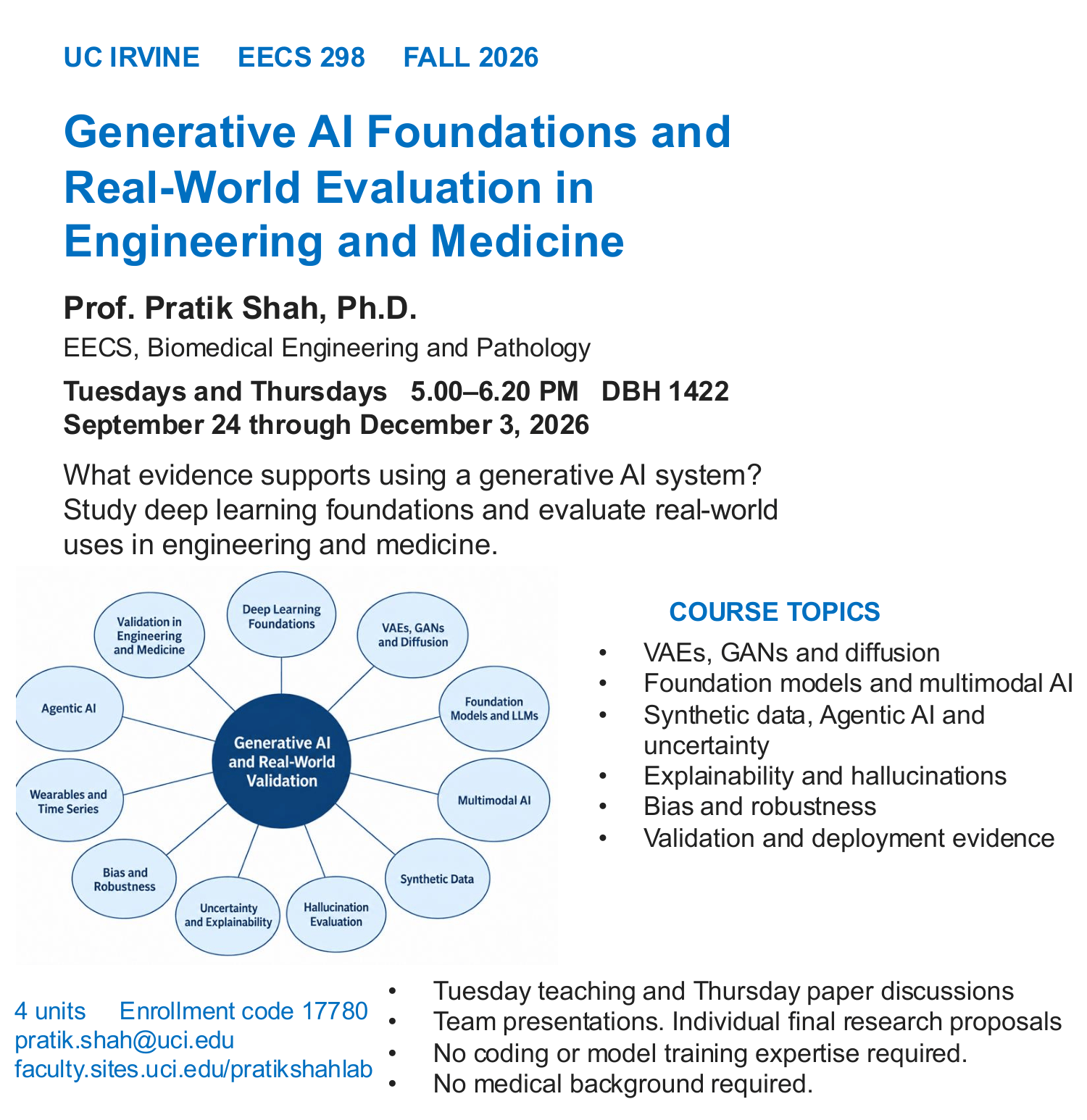
This course examines generative AI and its validation in engineering and medicine. Students learn the deep learning foundations of generative models, including latent representations, autoencoders, GANs, VAEs, diffusion models and transformers. The course also introduces foundation models, large language models and multimodal AI. The central question is what evidence is needed before an AI system can be used for a defined purpose. Students examine data quality, uncertainty, synthetic data, explainability, bias, fairness and performance under changing conditions. Each topic connects theory with research papers and a real-world validation problem. Readings include textbooks, peer-reviewed literature and research from the instructor’s group.
Goals and learning objectives
- Explain how major generative AI architectures learn representations and produce outputs.
- Define an intended use and identify the evidence needed to support it.
- Evaluate datasets, reference standards, baselines and independent testing strategies.
- Distinguish visual realism and fluent language from correctness and practical utility.
- Assess uncertainty, bias, fairness and robustness across populations and settings.
- Design a research proposal with clear validation criteria and meaningful failure tests.
Topics
- Deep learning foundations and latent representations
- Autoencoders, VAEs, GANs and diffusion models
- Ground truth, noisy labels and uncertainty estimation
- Synthetic data and generative imaging
- Explainability, counterfactual testing and model reliability
- Wearable signals and generative time-series methods
- Foundation models, LLMs, multimodal AI and retrieval
- Agentic AI and evaluation of systems that use tools
- Bias, fairness, hallucinations and distribution shift
- Real-world validation, deployment evidence and regulatory frameworks
Methods and evaluation approaches
Generative modeling: Representation learning, conditional generation, adversarial learning, variational inference, denoising diffusion and autoregressive generation.
System evaluation: Independent testing, reference standards, baseline comparisons, calibration, uncertainty estimation, subgroup analysis and stress testing.
Real-world validation: Structural fidelity, downstream utility, factual grounding, privacy, human evaluation and evidence appropriate to the intended use.
Guest speakers
Selected sessions feature researchers and practitioners from academia, industry and government. Discussions will examine how generative AI systems are developed, evaluated and used in practice. Course resources
Canvas for enrolled students https://canvas.eee.uci.edu/courses/86586
Classroom information https://classrooms.uci.edu/classrooms/dbh/dbh-1422/