Deep Learning for Generating Computational PIN-4 Immunohistochemistry Staining from Prostate Biopsy H&E Images

Motivation
Prostate cancer diagnosis relies on glandular architecture assessed on hematoxylin and eosin (H\&E) tissue sections. PIN-4 immunohistochemistry (IHC) is ordered to confirm or exclude malignancy based on AMACR/racemase expression and basal cell presence in the same glands raising diagnostic concern. However, PIN-4 IHC is performed on a serial tissue section, limiting direct spatial comparison between the H\&E morphology that indicated the need for IHC and the corresponding immunophenotypic signal due to tissue loss, sectioning depth, and deformation.
Technical Summary
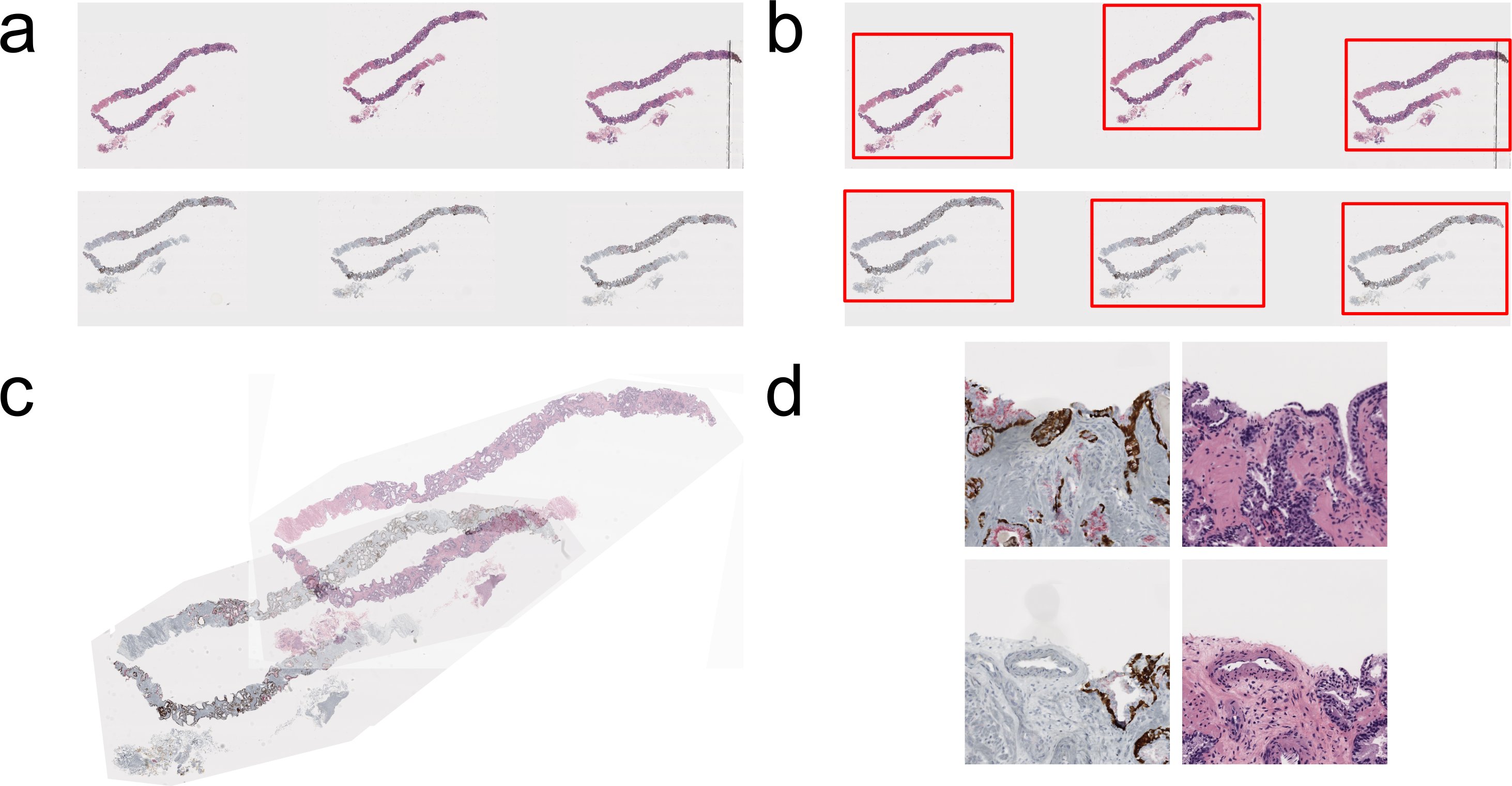
This project demonstrates supervised synthesis of PIN-4 IHC staining patterns from native brightfield H\&E prostate biopsy images using a conditional generative adversarial network (cGAN). A paired, registered H\&E/PIN-4 dataset was constructed from routine clinical prostate biopsy whole-slide images (WSIs) using a novel registration pipeline with core-level quality control. The final dataset comprised 172 paired WSIs from 93 patients and 27,298 registered 1024×1024 patch pairs spanning adenocarcinoma-positive and benign cases with representation across age, race, and ethnicity groups.
- H\&E Input: Native brightfield WSI patches at 20× magnification, 1024×1024 pixels.
- PIN-4 Target: Registered serial-section PIN-4 IHC patches from the same tissue block.
FAQ
What is the value proposition of this work?
This research demonstrates that computationally generated PIN-4-like signal can be reviewed in spatial context with the source H\&E morphology, preserving the co-localization that adjacent-section IHC cannot guarantee. The approach uses only standard brightfield H\&E images available in any clinical prostate biopsy workflow, without specialized imaging equipment.
What were the key findings?
Quantitative performance was evaluated on a held-out test set of 1,814 patch pairs from 17 WSIs:
- The model achieved a PSNR of 21.88 dB, indicating measurable pixel-level fidelity to registered native PIN-4 targets.
- SSIM of 0.667 exceeded values reported for H\&E-to-HER2 translation in breast tissue (approximately 0.34) and H\&E-to-GPC3 translation in liver tissue (0.458) in prior studies, suggesting that PIN-4 staining patterns may be more learnable from H\&E morphology than other IHC targets.
- PCC of 0.684 was higher than SSIM, reflecting stronger preservation of the spatial distribution of marker signal than fine staining texture, consistent with a model learning morphology-to-marker associations rather than exact pixel reconstruction.
- LPIPS of 0.417 confirmed perceptual similarity between generated and native PIN-4 images.
- Performance was consistent across training, validation, and test partitions, confirming generalization to held-out tissue blocks without substantial degradation.
Qualitative review by a board-certified pathologist confirmed the following:
- Generated images captured AMACR/racemase-like signal in suspicious and malignant-appearing glands while preserving basal-cell-associated staining in benign-appearing glands, indicating that the model learned morphologically grounded associations rather than color statistics.
- Spatial correspondence with the source H\&E morphology was maintained in strong-performing examples, supporting the use of generated images as a co-localized visual adjunct alongside native H\&E.
- Model errors including incomplete racemase-like signal and variability in basal-cell staining were observed predominantly in morphologically complex regions such as intraductal carcinoma and high-grade carcinoma, where training examples were limited.
What are the main outcomes and the meaning of this work for deep learning research and clinical applications?
The study provides a foundation for co-localized PIN-4 pattern review alongside H\&E morphology in prostate biopsy interpretation. Upon prospective clinical validation, computational PIN-4 could allow pathologists to inspect predicted marker patterns in regions where serial-section differences or tissue loss complicate comparison with native IHC.
What are the next steps?
Future work includes multi-institutional validation, WSI-level metric aggregation, and enrichment of training data for rare lesions including intraductal carcinoma and atypical small acinar proliferation. Generative model development could benefit from tissue-compartment-aware architectures that emphasize glandular epithelium over background and stromal areas.
Publications
- Deep learning for generating computational PIN-4 immunohistochemistry staining from prostate biopsy H\&E images. 2026. arXiv:2606.01871v1 preprint [https://doi.org/10.48550/arXiv.2606.01871]. Accepted for Publication, 25th IEEE International Conference on Machine Learning and Applications. 2026.
Contributors and coauthors
Vietbao Tran: Graduate student
Pratik Shah^: Principal investigator (^Senior and corresponding author).